
Talk to an Attorney
Talk to an Attorney
A slip and fall injury can change your life in an instant, leaving you with painful recovery, mounting medical bills, and lost income. When property owners fail to maintain safe premises, you shouldn’t have to carry the financial burden alone.
As an experienced Montgomery slip and fall lawyer team, Jinks Crow has successfully advocated for injured victims across Alabama for over 40 years. We fight to secure fair compensation for people like you. You don’t have to manage the claims process on your own. Let us handle the investigation, evidence gathering, and negotiations so you can focus on healing.
Contact Jinks Crow today for a free, confidential consultation to discuss your case and understand your legal options.
Jinks Crow has represented injured Alabamians for more than four decades. Our attorneys handle everything from routine premises liability claims to complex, high-value litigation across the state. The firm’s attorneys bring over 150 years of combined legal experience, with offices in both Montgomery and Union Springs so you get the reach of a large firm with the attention of a local one.
When you hire Jinks Crow, you get a team that knows Alabama’s premises liability law. We are not afraid to take a case to trial when the insurance company won’t offer a fair settlement. Consultations are always free and confidential, and you pay nothing unless we recover compensation for you.
Contact Us Now 334-738-4225
If you have been injured on someone else’s property, the steps you take are critical to the strength of your future legal claim. Property owners and their insurance companies often look for ways to minimize or deny your claim. They may question the conditions that caused your injury or try to shift blame onto you. Establishing a clear, documented record of the incident is one of your best defenses against these strategies.
If you have photos of the scene, save them securely. If you have not yet reported the accident, do so immediately, and ensure you have a written record of that report. Securing your medical records and documenting every detail of the hazardous condition is essential for proving the property owner’s negligence.
Alabama follows strict contributory negligence rules. That means your claim may be denied if you are found to be even 1% at fault. Any gap in your evidence can be used to deny your recovery entirely.
An experienced attorney can step in to manage this process, ensuring all necessary evidence is preserved, your medical records are properly coordinated, and that you do not inadvertently say anything to an insurance adjuster that could jeopardize your compensation.
Slip and fall accidents are injuries caused by a dangerous condition on real property or something built on it, like a parking lot, sidewalk, or building. Despite the name, they don’t always involve an actual slip or fall. A trip, an automatic door closing on someone, or an injury caused by a store display can all fall under this category.
Possible injuries include broken bones, fractured hips, bulging or herniated discs, severe strains, internal injuries, head injuries, burns, nerve damage, and in the most serious cases, death.
Alabama law places slip and fall cases inside a broader area of law called premises liability. How strong your case is depends heavily on your legal status when you were hurt. Legal statuses include:
Invitees. Property owners owe the highest duty of care to invitees. Invitees are people who are on the property for business purposes, such as customers in a store. Alabama courts have held that owners must use reasonable care to keep the premises safe for invitees, or warn them of dangers they know about (Unger v. Wal-Mart Stores East, L.P., 279 So. 3d 546 (Ala. 2018)).
Licensees. Licensees have the property owner’s permission to be on the property, but they are not there for business reasons. A social guest is a licensee. Licensees are owed only a warning about dangers the owner already knew about.
Trespassers. Trespassers have the least protection under Alabama law. A property owner generally owes no duty to a trespasser except to avoid causing intentional or reckless injury. But, there are limited exceptions. For example, if the owner knows a trespasser is on the property and in danger, the owner must use reasonable care to warn them (Ala. Code § 6-5-345).
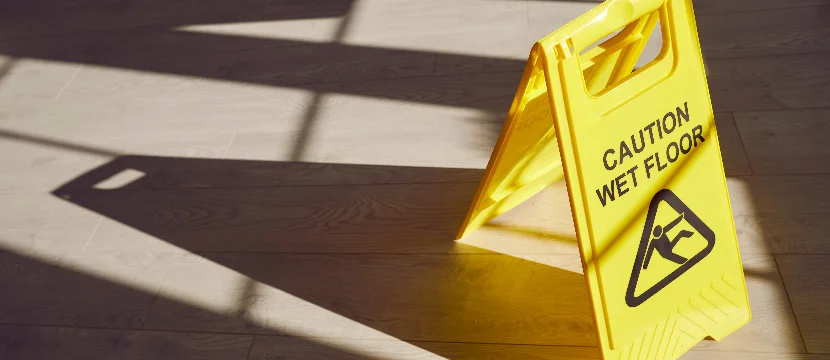
Property owners frequently raise what’s known as the open and obvious defense. For example, they may argue that a wet floor sign or similar warning means they can’t be held liable. That’s not automatically true. Whether a hazard is genuinely open and obvious is judged objectively, based on whether a reasonable person in the injured visitor’s position would have recognized the danger (Hines v. Hardy, 567 So. 2d 1283, 1284 (Ala. 1990)). That’s a fact-specific question, and a skilled attorney may challenge a property owner’s open and obvious defense with photos, maintenance records, and witness statements.
Alabama follows pure contributory negligence principles. Under this rule, if you are found even 1% at fault for your own fall, the property owner can avoid paying you anything at all. Insurance companies know this rule well and will look hard for any way to shift even a small share of blame onto you. This is one of the reasons to have a Montgomery slip and fall attorney investigate your case quickly, before evidence disappears and before you say something to an adjuster that gets used against you later.
Slip and fall accidents in Montgomery may occur on any property. They frequently occur in the following locations:
Property owners have an ongoing responsibility to inspect their premises and fix hazards before someone gets hurt.
The value of a slip and fall case depends on the extent of your injuries and how much the property owner knew about, or contributed to, the condition that caused your fall.
Depending on the facts, you may be able to recover compensation for medical bills, future medical care, lost wages, reduced earning capacity, and pain and suffering. In cases involving a death, surviving family members may be able to pursue punitive damages through a wrongful death claim.
An experienced trip and fall attorney in Montgomery can review your medical records and financial losses to help determine what your claim may be worth, since no two cases are valued the same way.
In most cases, you have two years from the date of your fall to file a lawsuit under Alabama Code § 6-2-38. If you miss this deadline, the court will almost always dismiss your case, no matter how serious your injuries are. Some exceptions can extend this deadline, including claims involving a minor, so it’s best to talk to a lawyer as soon as possible.
Yes. Alabama is a pure contributory negligence state, which means that if you’re found even slightly at fault for your own fall, you may be barred from recovering any compensation. This makes it especially important to gather evidence quickly and to avoid giving a recorded statement to an insurance adjuster before speaking with an attorney.
Not automatically. A sign doesn’t erase liability if the hazard existed for an unreasonable amount of time, wasn’t clearly placed, or wasn’t the actual cause of the fall. Each situation depends on the specific facts.

If you’ve been hurt in a slip and fall accident in Montgomery, Union Springs, or anywhere in Alabama, don’t wait to get help. Alabama’s contributory negligence rule means the insurance company only needs to find a small amount of fault to deny your claim entirely.
If your case moves forward in court, it will most likely be filed in the Montgomery County Circuit Court, the trial court of the Fifteenth Judicial Circuit, located at the Phelps-Price Justice Center, 251 S. Lawrence Street in Montgomery. Having local attorneys who know this courthouse and its procedures can make an already stressful process feel less overwhelming.
The dedicated slip and fall attorneys at Jinks Crow have more than 40 years of experience holding negligent property owners accountable across Alabama.

Managing Attorney

Attorney

Attorney

Attorney

Attorney

Attorney

Attorney

Of Counsel

Of Counsel

"*" indicates required fields
Copyright © 2026 Jinks Crow, PC. • All Rights Reserved. Disclaimer | Site Map | Privacy Policy. Digital Marketing By: 
*Images are obtained under license from Canva and other third-party stock image providers, with attribution included where required.